He Came as Samuel, Lived as Satyanand, and Left Himachal Prosperous
On 14 May, we all salute a great soul who, with his dedication and determination, transformed the hills from poverty to prosperity. On this day in 1945, he took his last breath at Ripon Hospital, Shimla – now DDU Regional Hospital.
Today, the beautiful bungalows and other modern amenities nestled among the apple gardens in the hills stand as a testimony to his vision and wisdom.
Samuel Evans Stokes (16 August 1882-May 14,1945) an American by birth who adopted India as his second home, was a social worker, missionary, philosopher, philanthropist, freedom fighter, soldier of Gandhi ji’s army, agriculturist, horticulturist, and above all, a man committed to mitigating human suffering. In a span of four decades, he worked tirelessly to ameliorate the suffering of those living in poverty and turned the hills from poverty to prosperity.
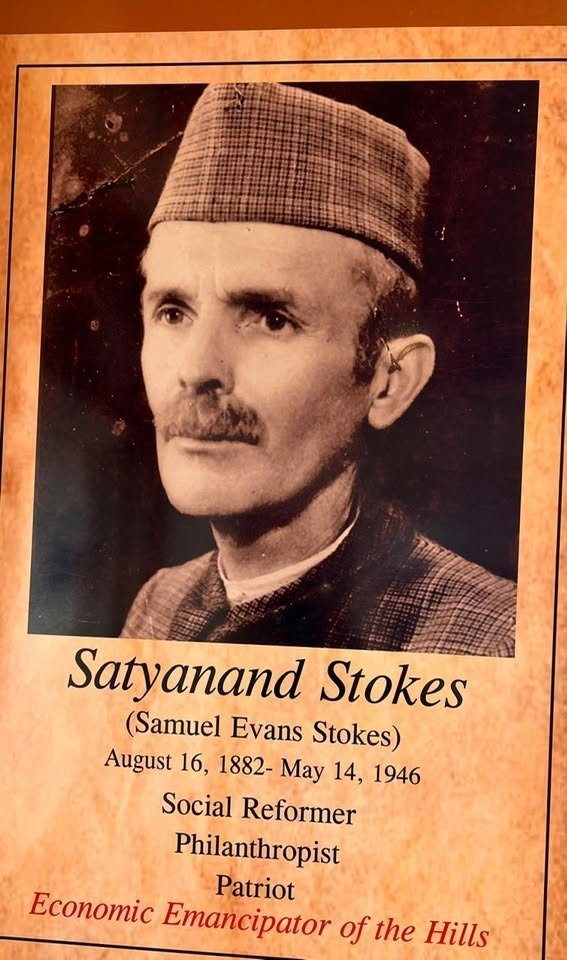
A Christian by birth, Stokes was impressed by the philosophy of the ancient Hindu religion, particularly the Arya Samaj, which had attracted a large number of progressive Hindus. He first came into contact with them during the Kangra earthquake in 1905, where Punjab Arya Samaj volunteers did creditable work. In February 1907, he attended the Gujranwala Religious Conference. This was where he first heard the religious views of Arya Samajists, who heavily influenced his thinking in later years. After the conference, he read a translation of Swami Dayanand Saraswati’s Satyarth Prakash, which deeply impressed him.
He learned Sanskrit so that he could read the Bhagavad Gita and other ancient religious texts (Asha Sharma: 2008, 221).
The Arya Samaj opened its first school in the hills at Dhada (Virgarh) in Kotgarh in 1920. The school, called the Himalaya Anglo Sanskrit Middle School, was inaugurated by the well-known Arya Samaj scholar and leader Mahatma Hans Raj. Stokes was influenced by the scholars and sanyasis of the Arya Samaj who started coming to Kotgarh after the school was opened there (Asha Sharma: 2008, 244). Stokes’ contact with the Arya Samaj was re-established during the days of the begar struggle when he sought the help of Lala Lajpat Rai. In his book Satyakama, he explained at length his interpretation of the Hindu religion (BK 883 – Indian Social Reformer, 1933, 82).
Gradually, Samuel became more and more attracted to Hindu Dharma. He wrote that the teachings of Hindu scriptures had cleared his doubts about Bhagavan. Finally, he approached Pandit Rishi Ram, a follower of Swami Dayanand Saraswati, and requested that he be converted to Hindu Dharma (Vishal Agarwal: 2016, 250–251).
In July 1932, Stokes wrote to his mother alerting her of his decision to become a Hindu: “I said, been too long a ‘benevolent outsider’; it was time to be come part of community itself.
At Chatramukh Temple in Mehlan on September 4, 1932, Stokes, along with his wife and children, embraced the Hindu faith in the presence of Sanyasi Ramanand Shastri of Sadhu Ashram, Hoshiarpur. The conversion ceremony, or shuddhi, was performed by Pandit Govardhan Das of Nirmand.
With this ceremony, Samuel Evan Stokes became ‘Satyanand,’ meaning ‘happiness in truth,’ and his wife became Priya Devi.
Differences had arisen in the State, particularly in the Kotgarh and Bushahr area, over the conversion of Mr. Satyanand Stokes to Hinduism. A deputation consisting of leaders of the Hindu Mahasabha, Sanatan Dharma, and Arya Samaj, led by Bhai Parmanand and including Swami Anand Giri, Yogi Jagnavanand, Gopal Das, Swami Parmanand, Mr. Vidyadhar, Babu Manohar Das, and Lala Gadu Ram, went to Bushahr State. After meeting with the Ruler, Bhai Parmanand informed the Press that the Ruler gave them a very sympathetic hearing and assured them that he and his predecessors had always allowed conversions to Hinduism. While pointing out that he could not force his subjects to take any particular view on the matter, he assured them that he would issue orders so that those who promoted the conversion of Satyanand Stokes would not be boycotted or persecuted. Bhai Parmanand said that the deputation had achieved its purpose.
Hence, Raja Padam Singh of Bushahr helped Stokes to be included in the Hindu religion. His influence and efforts bore fruit, and ultimately Samuel became Satyanand.
Stokes wrote a letter to Raja Padam Singh Sahib Bahadur, Sarahan on August 28, 1932:
*Dear Raja Sahib*,
For many years, as you know, I have been devoted to the service of these hills, and for the past fifteen years have been constantly more strongly inclined to the Hindu view of life. If you should see your way to facilitate me and my family being accepted into the Hindu community here, I shall most deeply appreciate it, and will try in the future, as I have in the past, to work for the uplift of those among whom we live.
Hoping that you will feel able to give your support at this time, I beg to remain, as ever,
Respectfully yours,
*Stokes*
On Sept. 6th, 1932, Stokes wrote another letter to Raja Padam Singh:
“I am writing to express my deep appreciation of your help and empathy in the matter of the ‘Milwartan’. It is a great happiness to me that I have been able to associate myself and my family with the Hindu fold of our hills, and it is my earnest desire that we may live to serve our neighbours in the future as we have tried to do in the past, but with the feeling that they are in every sense our own people.
For me personally, having been absorbed for the past twelve or fifteen years in the study of the Upanishads and Brahma Sutras, it is a special joy to think of myself as one with the ancient religion that they express, and I shall try to the best of my ability to prove faithful to their teachings and to the people of the hills.
I shall never forget the encouragement that you have given to us at a time when we so much needed it, and I am confident that you will extend the same help to us in the solution of other problems as they may arise.”
Satyanand, with his farsightedness, single-handedly transformed the hill economy by introducing apple cultivation. He may rightly be called the Father of Apples in Himachal. It is ironic that no major institution is named after him today. The apple economy now contributes around ₹6,000 crore annually to the state. A dedicated museum on the life and contribution of Stokes should be opened in the state capital, and a statue should be installed at the historic Ridge in Shimla, so that people can learn about his efforts in making the hills prosperous.
Vinod Bhardwaj
Honouring the Past. Illuminating the Present.