A lone crusader revives what the state forgot
Sunni, about 50 km from Shimla, was once the capital of Bhajji State and is an emerging town situated on the left bank of the Sutlej. Bhajji State was established in the 10th century by Uday Pal, the younger son of Raja Jas Pal of Kutlehr, who left his ancestral domain to found a new principality in the Shimla Hill region. The founding rulers traced their lineage to the Kaundinga Rajputs, a branch of the Pal dynasty with roots in the Kangra area, and held the title of Rana. The state was also under the control of Gurkhas and in 1815, after the Anglo-Gurkha War, it came under the control of the East India Company.
It is midway between Shimla and Karsog. The place came into the limelight when the Chaba Hydro-Electric Power House was commissioned in 1913 by the British government. The plant provided electricity to Shimla – the Summer Capital of Imperial India.
On the other side of the river lay Suket State. During the princely era, the river was crossed by rope bridges, by swimming, or on inflated animal skins. Missionaries and travellers mentioned the place in their travelogues. On weekends, British families came here for picnics and fishing.
Tattapani: Springs Submerged, Spirit Survives
Tattapani in Mandi district, about five km from Sunni, is renowned for its natural beauty, hot springs, and a serene lake recently formed due to the construction of the Kol Dam. The area offers a unique blend of scenic mountains, religious sites, and, now, recreational water activities promoted by private entrepreneurs. Tourists and devotees flock to Tattapani not only for its spiritual heritage, linked to the meditation of sage Jamdagni, but also for the revitalising experience of bathing in its sulphur-rich hot springs. A large fair is organised every year at Tattapani on Makar Sankranti.
With the formation of the lake, the historical hot-water springs, temple, and a British-era bridge were submerged. Now the springs have re-emerged near the Shimla-Karsog road. The local panchayat has built small concrete pools around the temple, but they are in a shabby condition. Some local families have provided bathing facilities near the roadside by boring wells. The State Tourism Department has completely ignored the importance of this place. The poor drainage system near the bathing area has turned the place into a mess.
Maharishi Debendranath Tagore’s Connection with Tattapani
Maharishi Debendranath Tagore, father of Rabindranath Tagore, visited Tattapani in 1859, when he was stranded in Simla for a year due to the First War of Independence. During his stay, he visited various places in the hills up to Sarahan.
In 1859, on the invitation of the Rana of Bhajji, he visited the area. He meticulously described the place, its people, and the economic conditions of that period in his autobiography.
Maharishi Devendranath narrated:
“Towards the end of Magha (January-February), when I was absorbed in meditation on Brahma, a man of quality came to see me. ‘I am the minister, the vizier of the Rana of Bhajji,’ said he. ‘The Rana Sahib has sent me to invite you.’”
On the Rana’s invitation, he visited Sunni. On his arrival, the royal guru, Sukhanandanath, welcomed him. The royal guru had earlier met Devendranath at his own guru Hariharananda Tirthaswami’s residence in Rammohan Roy’s garden, Delhi.
Maharishi Devendranath Tagore wrote in his autobiography:
“Next morning I went alone for a walk on the banks of the river Sutlej. It was about as broad here as the river Jalangi in Krishnanagar – its waters were as blue and bright and clear as the sea. Like the poet Valmiki’s river Tamasa, ‘clear as the minds of the good’, was an apt simile for the waters of the river Sutlej here. I crossed the river on a water-skin. Wooden boats were of no use in this river, because big rocks were embedded in its course. Water-skins were the only possible means of crossing over. On reaching the other side I found the water there as hot as the Sitakunda of Monghyr. Particularly strange is the fact that, as the river swells and broadens in the rains and occupies the place of the hot water, the latter also advances in line with it and remains hot along the bank. I saw many sick people had come to bathe there. They say it cures many kinds of diseases.”
At the entrance of a hotel in Tattapani, the information about Tagore’s visit is wrongly written:
“The place was visited by Noble Laureate Gurudev Rabindranath Tagore in the year 1938 whereas his father Debendranath Tagore visited the place in 1859.”
Dr. Rajendra Prasad’s Footsteps at Tattapani
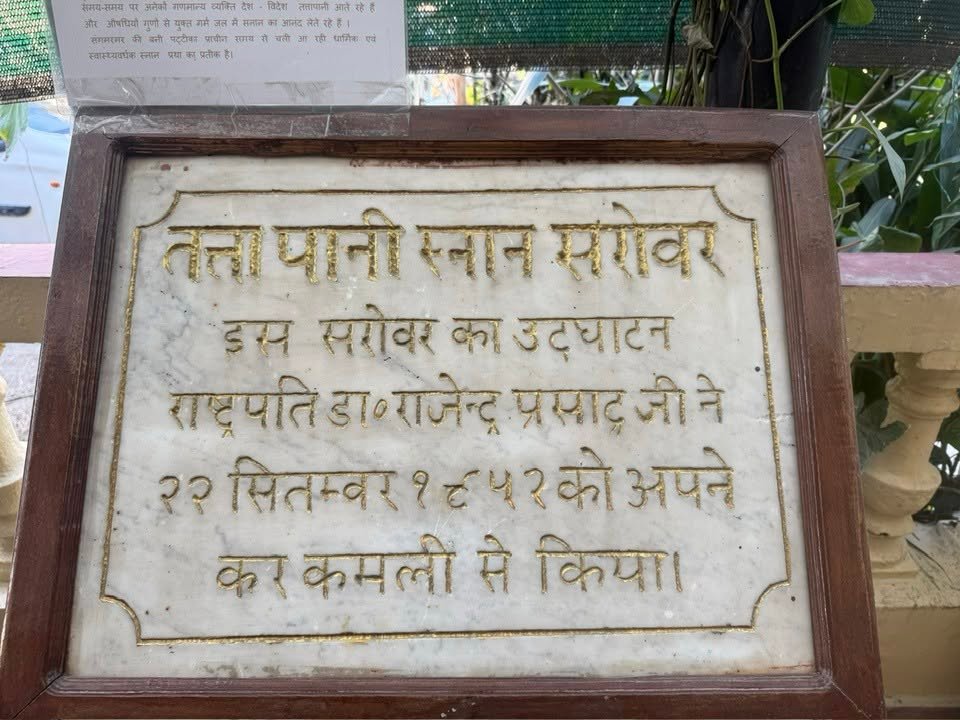
The first President of India, Dr. Rajendra Prasad, visited Tattapani on September 22, 1952, during his visit to Shimla and inaugurated the hot-water bathing sarowar. Yet, there is no official plaque mentioning the arrival of Maharishi Debendranath Tagore in 1859 and President Dr. Rajendra Prasad in 1952 at this religious place.
A New Adventure Sports Destination, But Official Apathy Continues
Tattapani is close to Shimla, but since Independence, successive state governments have shown no interest in developing the area.
In 2025, during the monsoon season, the swollen Sutlej damaged the main road linking Shimla with Mandi district. In the past year, the damaged road has not even been repaired, showing the lacklustre attitude of the state machinery. The small town remains dirty despite being a major halting point for buses plying on the Shimla-Karsog-Sundernagar road and other interior routes.
According to Shri Thakur Dass Sharma, a retired Executive Engineer, the steel truss bridge on the Sutlej at Tattapani was built in 1960-61 by the Public Works Department, and bus and vehicle traffic started on this road in 1961. Before that, a ropeway bridge was constructed by the British for pedestrians and mules to cross the river near the site of the old bridge. People of the area used to walk to Durgapur, near Naldehra, to catch a bus. The Shakra bridge was constructed in 1986. These road links changed the economy. During the princely era, agricultural and forest products were transported on mule-back to Shimla.
The new concrete, high-level bridge at Tattapani was constructed and opened around the mid-2000s. It was built at an elevated height in conjunction with the Kol Dam Hydroelectric Project, as the dam’s reservoir submerged the original low-lying bridge and the natural hot springs.
A Lone Crusader: Prem Raina
A visionary, Mr. Prem Raina has emerged as an enterprising businessman who built a successful tourism business that has generated employment for local residents. He single-handedly brought Tattapani onto the adventure sports map. In 1992, he opened a soft-drink vendor stall on the bank of the Sutlej. His story is one of rags to riches. He started his business with just Rs 100, selling cold drinks on the banks of the Sutlej.
Destiny took him to Milan, Italy, where he opened an Ayurvedic Panchakarma centre. His love for his motherland brought him back, and he started “At Home” with his Italian wife. Later, in 2007, he opened the Hot Spring Hotel. Today, he owns two hotels at Tattapani, a resort at Kufri, and another at Chindi.
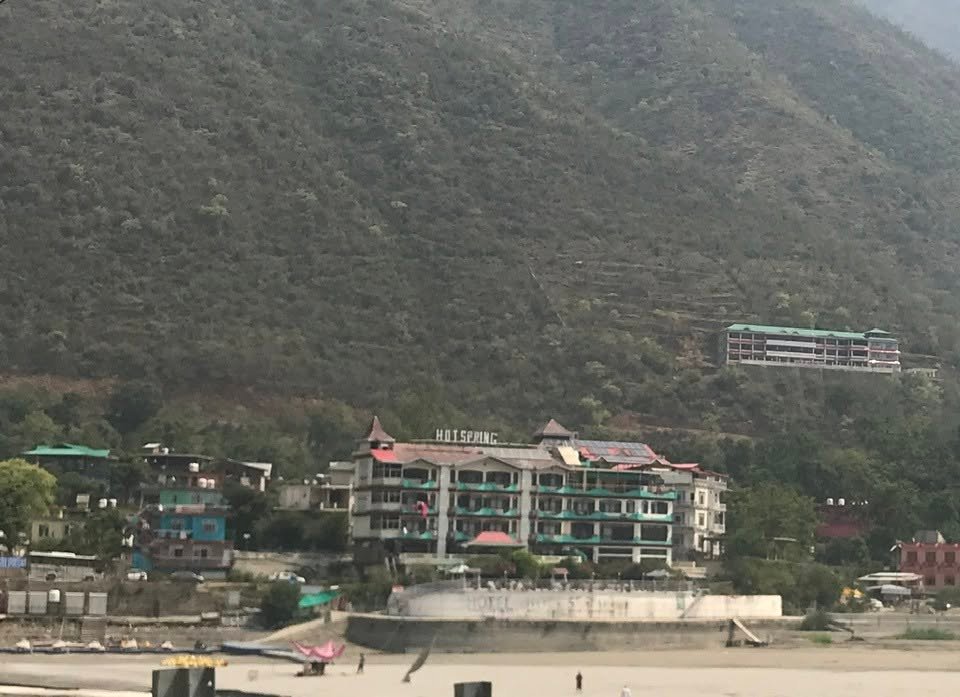
The uniqueness of his hotel is that it is one of the few hotels in India that provides piped sulphur water sourced from a natural hot-water sulphur spring. The hot-water pools are meticulously designed and well-maintained as an open swimming pool with independent bathrooms.
Besides this, the resort also has facilities for adventure sports, rafting, and Ayurvedic Panchakarma. According to his brochure, it is a full-fledged Ayurvedic naturopathy and yoga health centre. The naturopathy facilities include hydrotherapy, mud therapy, massage, physiotherapy, acupuncture/acupressure, diet therapy, and yoga.
Today, Prem Raina and Tattapani are synonymous with each other. In 1913, the British constructed the Chaba project which lit up Shimla, and in 2007, Prem Raina built the Hot Spring Hotel at Tattapani, which became a lighthouse of adventure sports and Ayurvedic Panchakarma in the state.
Vinod Bhardwaj
Honouring the Past. Illuminating the Present.